Transforming Tables Compared: Which Type Is Right for Your Space?

A dining table can take up a lot of space, even if you use it only a few hours a day or a few times a month. When one room needs to serve several purposes, a transforming table can help make better use of the space.
Some transforming tables shift from coffee height to dining height. Others expand to accommodate a larger group, fold away against the wall, or provide a surface that can move between dining, working, and everyday living. There is a lot to consider when selecting which table works best for you, but it starts with understanding how you want to use your space.
Before comparing styles, start with your everyday routine. How often do you dine at the table? How many people typically use it? What else needs to happen in the room? And when you are not dining, what would you rather do with that space?
Start With How You Use the Room Every Day

Before choosing a transforming table, start with the room itself: what does it need to do on an ordinary day?
Think about whether the table will be part of your daily routine or something you use occasionally. Do you sit down for meals every night, or only when guests come over? Is the table usually serving one or two people, or does it need to make room for a larger group on weekends or even host a holiday?
It also helps to consider what happens when the table is not in use. In some spaces, reclaiming floor area is a priority. The right table should give you the surface you need without asking the room to give up more space than necessary.
Then there are the other roles the table may need to play. Will it double as a desk, a project surface, or a place for children to work? Will chairs need to live nearby, tuck away, or be brought out only when entertaining? These details can make the difference between a table that technically fits and one that actually makes the room easier to live in.
The shape and flow of the room matter, too. A table should support movement, not interrupt it. Consider where people will walk, how chairs will be arranged, and how the room feels when the table is fully in use versus tucked away.
The Main Types of Transforming Tables
Transforming tables can solve very different spatial challenges. Understanding how each type functions is a useful first step in narrowing the options.

Coffee-to-Dining Tables
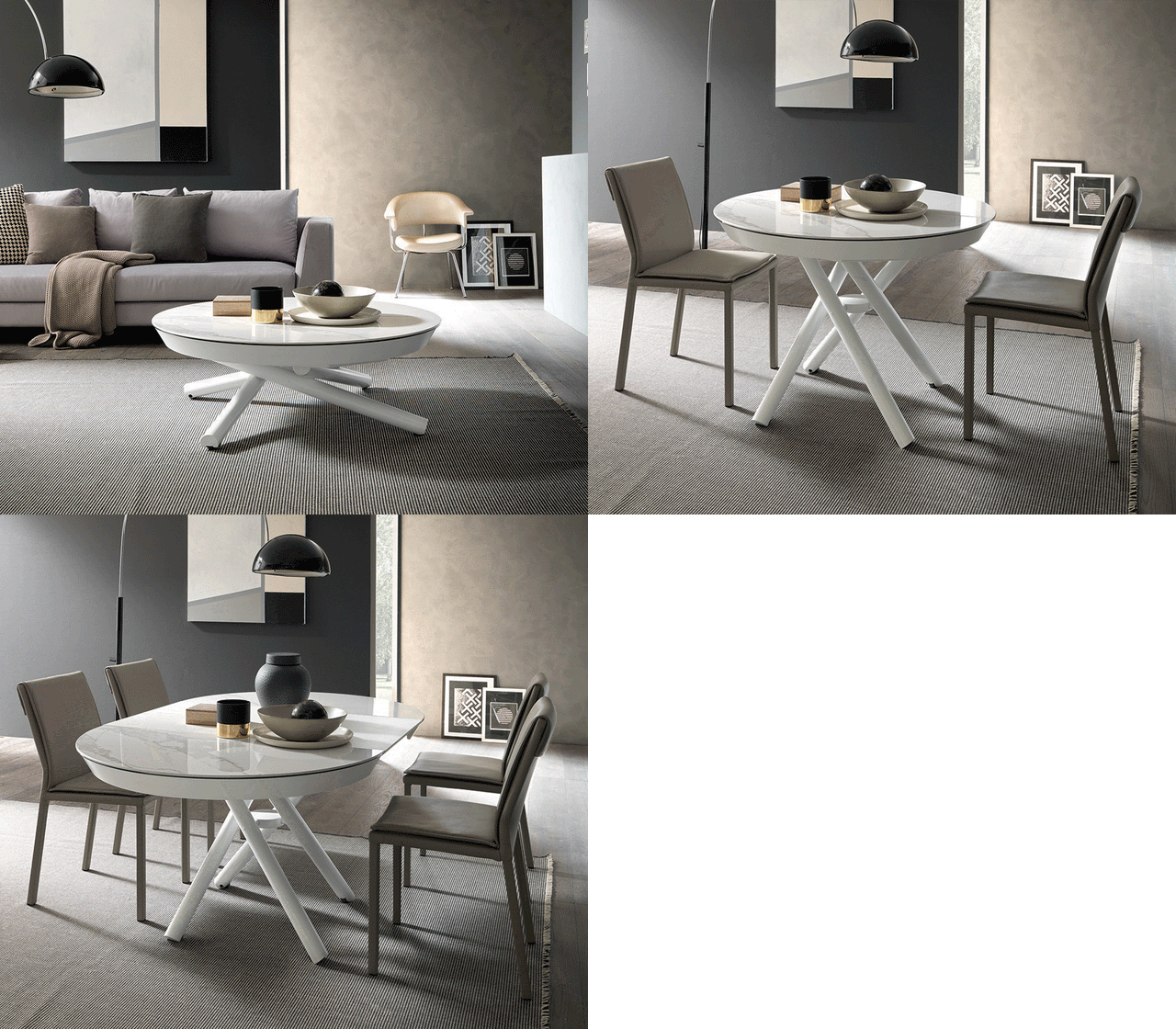
A coffee-to-dining table allows the same piece of furniture to serve two distinct roles. At its lowest setting, it functions as part of the living area. When you need dining space, the table rises to dining height, and many designs also expand to create a larger surface.
This works especially well in studio apartments, smaller homes, where a permanent dining table would take up too much space.
The Brooklyn transforms from a square coffee table into a rectangular dining surface and is available in two sizes, Standard and Mini. Its range of sizes makes the same concept adaptable to different floor plans.
For greater dining capacity, the Passo adjusts to accommodate up to ten people. When lowered, it can also fit beneath select Resource Furniture wall beds, allowing the same room to transition between living, dining, and sleeping without moving the table elsewhere.
The Soleil features a circular top and expands into an oval dining table that seats up to six. Its pedestal base creates a clean, architectural profile that feels polished without adding visual weight.
The Ceres uses a telescopic base to rise from coffee to dining height. Its top then slides apart to reveal two hidden leaves, creating a dining surface for up to eight. The self-contained leaves keep the extensions stored neatly within the table, so there is no need to find a separate place for them when they are not in use.
A coffee-to-dining table may be right for you if: dining is an occasional function of a room rather than its primary purpose, and you want to preserve more open living space from day to day.
Extendable Dining Tables

An extendable dining table allows you to seat more people at the table when you need to. This is a good option if you use the dining table every day but occasionally need more seating when people come over.
The Amalong uses a patented mechanism to unfold two concealed leaves from its solid ash or walnut frame. The leaves extend from the short sides of the table, increasing seating up to twelve, making it suitable for both everyday meals and larger gatherings.
The Plurimo expands in both width and length. It is available in multiple sizes that can all be ordered in dining, counter, or bar height. Its versatility allows you to customize its size to specific moments. Its largest size accommodates up to twelve people when fully extended.
If you prefer a circular table, the Luna expands from a circle into an oval using a telescoping mechanism. Depending on the selected size, it can seat up to six or eight.
The Elegance also begins as a round dining table but extends to nearly 95 inches long, with seating for up to eight. Its solid ash legs and beveled top give it the look of a refined dining table in both configurations.
An extendable dining table may be right for you if: you want a dedicated dining surface every day but need additional seating when entertaining.
Tables That Adapt to More Than Dining

Sometimes the table needs to do more than make room for additional guests. A multifunctional table lets one surface support several different activities as the day changes.
The Dynamic Collection includes height-adjustable tables that can transition from side-table or coffee-table height to a work or dining surface using a lever-operated mechanism. Multiple sizes, including extra-large Dynamic Plus configurations, make the collection adaptable to different uses and room sizes.
The compact Genie table takes height adjustment even further, moving from just 4 inches high to 29.5 inches. When fully lowered, it can fit beneath select Resource Furniture wall beds. This makes it especially useful in rooms that may function as a living area, workspace, dining space, and guest room at different times.
The Giro keeps a low profile as a wall-side console, then pivots 90 degrees into the room and opens to create a dining or work surface when the moment calls for it. Integrated shelving and optional storage, including a file drawer, allow it to support a home office without requiring the room to function as a dedicated office all day.
A multifunctional table may be right for you if the surface needs to support several activities, such as working, dining, and everyday living, within the same room.
Wall-Mounted Tables

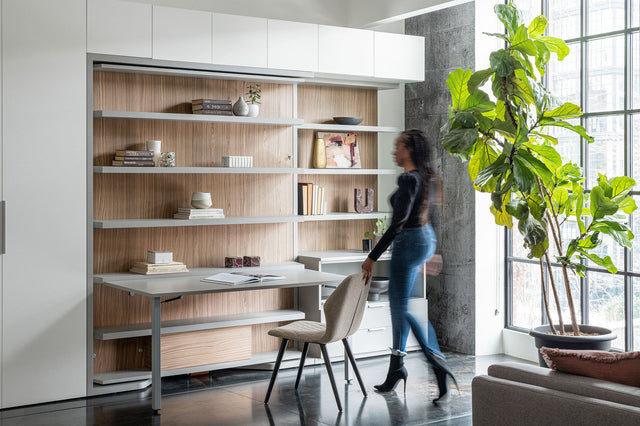
In especially small spaces, a wall-mounted folding table can create a usable dining or work surface without requiring permanent floor space. A wall-mounted dining table can be especially effective in compact kitchens, multipurpose rooms, studios, or other areas where maintaining clear floor space between uses is important.
The Wally transforms from a slim wall-mounted unit into a dining table or workstation. Integrated storage, wire management, USB ports, and optional features such as internal outlets and LED lighting allow it to function as more than a simple fold-down surface.
The Specchio takes a different approach by disguising the table's secondary function entirely. When closed, it appears as a wall-mounted mirror. With a single movement, the mirror transitions into a spacious dining or work surface.
A wall-mounted table may be right for you if: you want the table to occupy little or no floor space when it is not being used.
Transforming Tables at a Glance
| Table Type | Everyday Configuration | Best For | How it Changes |
|---|---|---|---|
| Coffee-to-Dining | Coffee Table | Studios, living rooms, and multipurpose spaces | Changes height and, depending on the model, expands |
| Extendable Dining | Dining Table | Everyday dining and entertaining | Expands to provide additional seating |
| Multifunctional | Varies by design | Rooms used for working, living and dining | Changes height, position or function |
| Wall-Mounted | Folded against the wall | Compact spaces and maximum floor-space flexibility | Folds down to create a work or dining surface |
Which Transforming Table Is Best for Your Lifestyle?

Product dimensions matter, but you should consider what you need the room to accomplish before deciding which table works best for you.
If You Eat at the Table Every Day, but Occasionally Entertain
An extendable dining table is a natural fit when you use the table every day but occasionally need space for more guests. It remains at dining height, so you are not changing the function of the room, only the table’s capacity. Start with the number of people who regularly use it, then consider the maximum number you realistically expect to host.
If Your Living Room Needs to Stay a Living Room
A coffee-to-dining table allows the dining surface to become part of the living-room furniture when it is not needed for meals.
If Floor Space Is Your Biggest Priority
Consider a wall-mounted table.
When folded away, the floor can remain available for circulation, exercise, play, entertaining, or whatever else the room needs to support.
If You Need One Surface for Work and Dining
Consider a transforming console.
The Giro can provide a work surface when needed while remaining integrated with wall storage when not in use. Height-adjustable tables can offer another option when the same area needs to transition between living, working, and dining.
What to Measure Before Choosing a Transforming Table

It is easy to focus on how little space a transforming table occupies when closed. The more important measurement may be how much space it requires when fully open.
Before choosing a table, consider:
-
Closed dimensions: How much room does the table occupy every day?
-
Fully extended dimensions: Will the largest configuration actually fit within the room?
-
Chair clearance: Is there enough room for chairs and people to comfortably sit at the table?
-
Circulation: Can people move around the table when guests are seated?
-
Seating capacity: How many people do you realistically need to accommodate?
-
Extension-leaf storage: Are leaves stored within the table, or will you need somewhere else to keep them?
-
Adjacent furniture: What happens to sofas, chairs, storage, doors, and other furniture when the table expands?
-
Other transformations: If the room contains a wall bed or another transforming piece, can the table remain in place when that system is open?
This last consideration is especially important in a fully multipurpose room. A table may fit beautifully when the bed is closed but create a conflict when the room transitions for overnight guests. A wall bed with an integrated table designed to lower beneath the bed can allow both functions to coexist without requiring furniture to be moved into another room.
Think about the entire room in both its everyday and occasional configurations, not simply the dimensions of an individual piece.
What Makes a High-Quality Transforming Table?

A transforming table should be simple to operate and feel steady in every position. Because it is designed to move often, the quality of its mechanism, materials, and construction matters just as much as how it looks.
It should also feel considered in every configuration: lowered, raised, folded away, or fully extended. The right finishes and customization options will help the table feel like part of the design rather than a piece chosen only for function.
Seeing the transforming tables in person can make the decision much clearer. In a showroom, you can operate each model yourself, compare mechanisms and finishes, and a Sales and Design consultant can also help you think through dimensions, seating, circulation, and overall function of the room.
Choosing the Right Transforming Table
There is no single table that works for every home. The right choice depends on what it would take to make your space work best for you. Consider your routine, available space, seating needs, and preferred style to find the best fit.
Schedule an appointment to explore Resource Furniture's collection of transforming tables and find a solution tailored to your space.
Frequently Asked Questions About Transforming Tables
What is a transforming table?
Transforming tables are designed to change size, height, position, or function to support different uses, moving from coffee to dining height, expanding for more guests, pivoting from a wall unit, or folding away when it's not needed.
What is the difference between an extendable table and a transforming table?
An extendable table stays a dining table but transforms to seat more people. Transforming tables are a broader category and may change height, size, position, or function; for example, a coffee-to-dining table changes both height and dining capacity.
Can a coffee table transform into a dining table?
A coffee-to-dining table is specifically engineered to rise from coffee-table height to dining height. Some models also expand to provide a larger dining surface, allowing a living area to accommodate meals without requiring a permanent dining table.
How many people can a transforming table seat?
Seating capacity depends on the table and its configuration. Compact models may be designed for smaller gatherings, while larger transforming and extendable tables can accommodate ten or twelve people. Always consider the table's fully extended dimensions, along with the space required for chairs and room circulation.
What type of transforming table is best for a small space?
It depends on how the room is used. A coffee-to-dining table can work well when a living room also needs to accommodate dining. A wall-mounted table can preserve maximum floor space between uses, while a multifunctional table may be better when the same surface needs to support working, dining, and other activities.
Recent Posts

The West Coast Design Calendar: Los Angeles, San Francisco, and Seattle This Fall

A Battery Park City Home Built for Change

The Room Between Visits: Rethinking an Underused Bedroom in Los Angeles

Transforming Tables Compared: Which Type Is Right for Your Space?

Two Projects, One Idea: Young Huh Designs for Flexibility