How to Design a Studio Apartment That Actually Works

Some studio apartments feel like a hotel room after a long trip: the bed is always in view, the laptop has taken over the table, and the chair by the window has become a closet with legs.
A well-designed studio never feels like you’re choosing between activities. Learning how to design a studio apartment is less about fitting everything into a smaller footprint and more about choosing what the room needs to become throughout the day. Coffee can happen before the workday, dinner can follow without a full reset, and sleep still feels like sleep.
What Is A Studio Apartment (And How It Actually Works)
A studio apartment is a home where the main living areas share one open room. Sleep, work, dining, and lounging happen in the same space, while the bathroom is separate. It is one room carrying the daily jobs of a home.
In a studio apartment vs one bedroom, the difference is simple: a one-bedroom has a separate room with a door. A studio keeps daily life together, which makes layout and furniture choices more important. A loft may share the open-plan idea, but it is usually larger, taller, and more industrial in feel.
Studios work well for remote workers, downsizers, city dwellers, ADU owners, and those who value location over extra square footage. The best studio apartment ideas start with use, not size: what the room needs to do, and how easily it can shift.
How Much Space Do You Really Need In A Studio Apartment?
In small apartments, layout matters more than square footage. Start with an ordinary Tuesday: morning coffee before the workday, space for a quick stretch, conference calls that need a real backdrop, and dinner that shouldn’t require clearing the whole room first. With the right layout and furniture, a well-designed studio can often function more efficiently than a poorly planned one-bedroom.
In most studio apartments, the bed is the single largest piece of furniture—and the least flexible. It defines the room even when it is not in use, sitting there all day, quietly winning. A wall bed reverses that relationship. Instead of the room adapting to the bed, the bed adapts to the room.
Without walls to define each area, visual cues have to do the work. A rug can mark the living area. Lighting can separate a work corner from the sleep area. Closed storage keeps the kitchen, office, and closet from visually merging into one long errand. Vertical storage keeps the floor from doing all the work. This is where space-saving furniture helps.
The Best Furniture For Studio Apartments (That Maximizes Space)
The best furniture for a studio apartment should improve more than one part of the day. In high-end studio design, the goal isn’t just to save space—it’s to elevate how the space feels and functions. The right pieces don’t look like design compromises. They feel intentional, integrated, and quietly efficient.
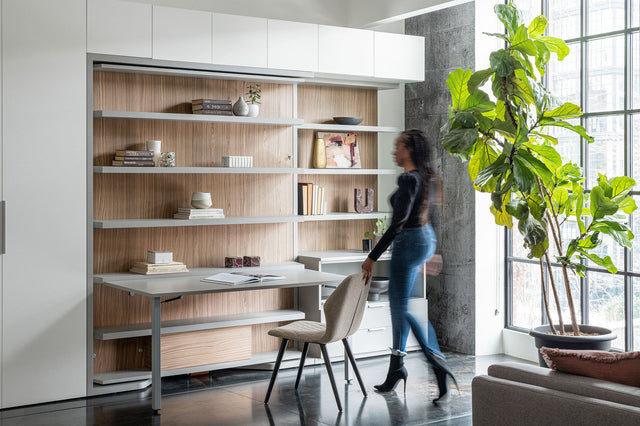
A standard bed improves the night, but a well-designed wall bed improves the hours when the bed is not needed. Closed, it can function as cabinetry, shelving, a sofa system, or a workspace; open, it becomes a real bed again. In the right studio, wall beds for studio apartments feel architectural, not improvised.
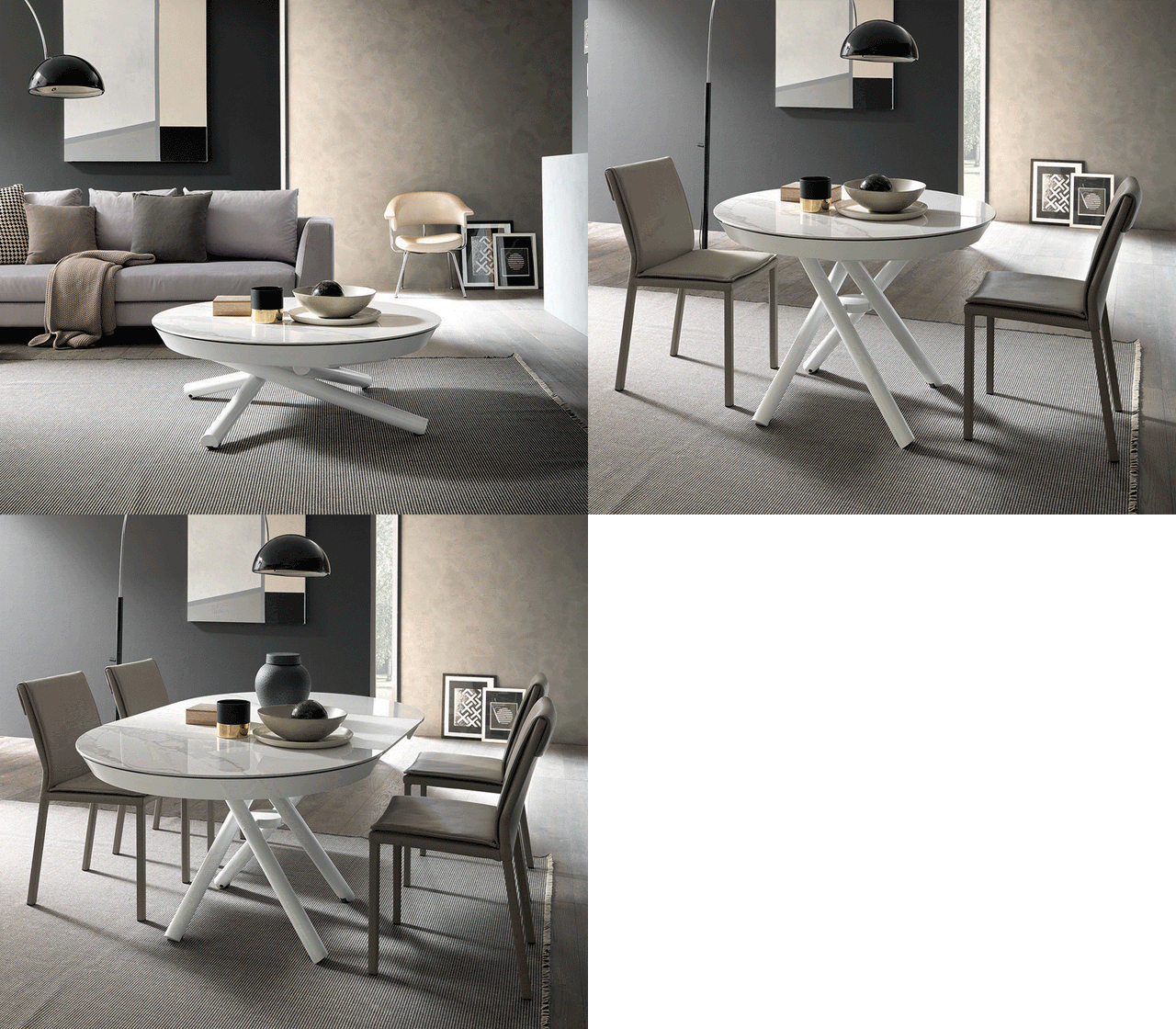
Tables deserve the same thought. Transforming tables can stay compact most of the week, then become a real dining surface when company comes. In a premium city apartment, a table that handles coffee, work, and dinner for four is a more useful kind of luxury than a dining area waiting around for special occasions.
For storage, avoid pieces that look like emergency solutions. Tall cabinets, wall systems, and integrated storage give the apartment a backbone. Look for smooth hardware, durable finishes, and systems that feel intuitive.
How To Design A Studio Apartment That Works For Real Life
Start with the sleep zone. If the bed will stay out, give it a clear edge with lighting, a rug, or storage. If you want the room to work harder, choose a wall bed system and plan around the open floor it creates. For the work zone, keep the setup simple: a real desk surface, nearby outlets, good light, and a chair that can live in the room.
For dining and lounging, choose pieces that earn their footprint. Two comfortable chairs and an expandable table may do more for daily life than a large sofa that blocks circulation. For an ADU, intuitive handles, durable finishes, and simple layouts help guests settle in without a tutorial.
A studio can feel limiting when people have to imagine how it might work. It feels considered when the bed, table, storage, and seating already make the case. Instead of asking someone to imagine how they might live there, the apartment shows them.
Designing a studio becomes much easier when you can experience how a space transforms in real time. Visiting a Resource Furniture showroom allows you to see how wall beds, tables, and storage systems adapt throughout the day—and how a single room can support the many demands of daily living. Bring your floor plan or measurements, and our design team can help you make the room make sense.
Photography: Erin Derby
Recent Posts

The West Coast Design Calendar: Los Angeles, San Francisco, and Seattle This Fall

A Battery Park City Home Built for Change

The Room Between Visits: Rethinking an Underused Bedroom in Los Angeles

Transforming Tables Compared: Which Type Is Right for Your Space?

Two Projects, One Idea: Young Huh Designs for Flexibility