How a Historic Park Slope Brownstone Made Room for Work, Family, and Guests
Designed for Work, Ready for Guests

In this Park Slope townhouse, Frances Mildred approached the design with a clear understanding of both the home and the people living in it. Founded by Brian Papa and Lauren MacCuaig, the practice is known for architecture and interiors shaped by craftsmanship, thoughtful design, close collaboration, and a long view of how spaces are lived in over time. That perspective feels especially evident here.
The clients had spent time upstate during the pandemic but found themselves pulled back to Brooklyn, where friends, family, and daily support mattered more. When they began looking for a permanent home, they were drawn less to polished flips than to places with character. In Park Slope, they found a narrow 1870s brownstone that needed major work but still held onto its original details and a strong sense of personality. They bought it in August 2021 and brought in Frances Mildred and J’s Custom Contracting to help shape its next chapter.

At 3,400 square feet across four stories and a cellar, the house is substantial, but its proportions still required careful planning. At just 17 feet wide, every room had to be used thoughtfully. The clients were also designing for real life: they were growing their family, building a long-term home, and wanted space for visiting parents to stay comfortably. The goal was not simply to fit in more. It was to make the house feel more capable, more comfortable, and easier to live in day to day.
That thinking shaped the project throughout. Frances Mildred preserved and reworked details from the original house while updating it for the way the family lives now. The renovation also followed passive house principles, the most rigorous set of standards for energy efficiency; this was in line with the clients’ values around sustainability, and among Frances Mildred’s areas of expertise. Across the house, several rooms were designed to serve more than one purpose, including an open kitchen centered on a long worktable that also functions as a dining space.
One of the clearest examples of that approach is on the second floor: a compact room with a leafy view that now works as both a home office and a guest bedroom.
This was an important space to get right. The clients needed a practical room that could support everyday work while also welcoming family when needed. Too often, that kind of arrangement feels like a compromise in one direction or the other. Either the workspace feels temporary, or the guest setup feels secondary.
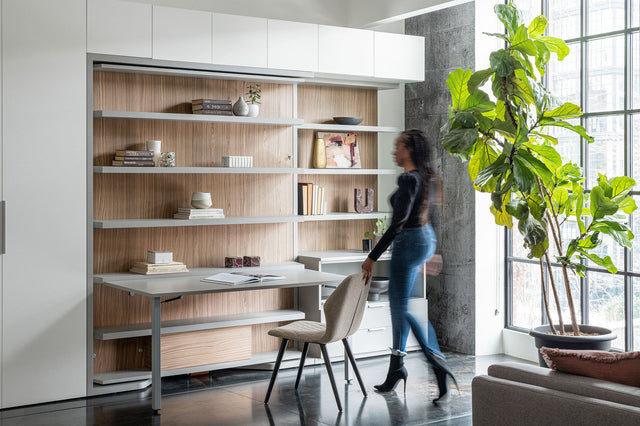
Frances Mildred found a thoughtful answer in the Penelope Desk from Resource Furniture: “The functionality was perfect, it almost felt like it was custom-designed just for this specific home.”
Closed, the piece provides a usable desk surface for daily work. Open, it becomes a guest bed. The shift between the two is simple and intuitive, which was a major part of its appeal. “The ‘aha’ moment was pretty instant.” As the design team shared, the functionality felt immediately right for the home and the way the family lives. Just as importantly, the desk does not need to be cleared before the bed comes down. That detail makes a real difference. It allows the room to transition easily, without adding friction to the routine.
That ease is what gives the room its value.

Multifunctional design works best when it feels natural in use. It should not require a complicated setup or ask people to constantly rearrange their lives around the furniture. In this room, the office remains a true office until the moment it needs to become a guest room. Then it changes over without fuss. The result is a space that supports both uses well and feels complete in each one.
The visual approach was just as considered. Frances Mildred’s work often reflects an interest in material, texture, and the quiet character that develops in spaces designed to be lived in. In this townhouse, the team wanted to respect the home’s history and preserve what made it distinctive. The previous owner had introduced richly patterned wall coverings throughout the house, and Frances Mildred chose to carry that spirit forward rather than erase it.
In the guest room, that meant a finish that connects the Resource Furniture piece to the larger design language of the house. The Penelope Desk was finished in Lewis & Wood wallpaper, helping it sit comfortably within the room rather than stand apart from it. That integration matters. The best multifunctional pieces do not feel like add-ons. They feel like part of the architecture of the space and part of the larger story of how a home works.
More broadly, it reflects a way of thinking that runs through the entire house and through Resource Furniture’s approach as well: living well does not require more square footage. It requires better solutions that make a space work harder and feel better, with design that supports everyday life in a clear and lasting way.

In this project, Frances Mildred used Resource Furniture to do exactly that. The guest room now supports work, welcomes family, and fits naturally into the character of the home. For the clients, that means a house that reflects how they actually live: full, evolving, and in motion, without giving up comfort or beauty.
That is often the difference between a room that looks finished and one that truly earns its place.
To experience Resource Furniture’s multifunctional collection in person, book a showroom or virtual consultation and explore solutions designed around the way you live.
Photography: Seth Caplan | seth-caplan.com, Jason Roth | jasonrothphotography.com
Recent Posts

The West Coast Design Calendar: Los Angeles, San Francisco, and Seattle This Fall

A Battery Park City Home Built for Change

The Room Between Visits: Rethinking an Underused Bedroom in Los Angeles

Transforming Tables Compared: Which Type Is Right for Your Space?

Two Projects, One Idea: Young Huh Designs for Flexibility