5 Garage Conversion Ideas to Inspire Your Next Home Upgrade

Your garage is probably sitting there, half-full of stuff you don't use, taking up prime real estate. But what if that space could be something more? A cozy guest bedroom, a proper home office, your own personal gym, a creative studio, or even a rental unit that brings in extra cash each month.
The best part? You don't need to build an addition or mess with your home's footprint. The structure is already there. You just need to reimagine it. In this guide, we'll walk through five garage conversion ideas and show you how the right furniture can turn that concrete box into something pretty amazing.
In this article:
Why Your Garage is Worth More Than You Think
Garages aren't just for cars and storage anymore. Homeowners are realizing that with some insulation, decent flooring, and smart furniture choices, a garage can become one of the most useful rooms in the house. Swap that garage door for glass panels and suddenly you've got natural light and indoor-outdoor flow. Add a Murphy bed and some modular storage, and you've got a guest suite that rivals a boutique hotel.
The key is to stop thinking of your garage as just a garage. It's a blank slate.
Why Bother Converting Your Garage?
Here's why this makes sense:
You're adding space without the nightmare of major construction. No new foundation. No extending your roofline. You're working with what's already there, which means less time, less money, and way less hassle than building an addition from scratch.

You get a room that's actually designed for what you need. Maybe you're tired of working at the kitchen table, or you need somewhere for guests to stay that isn't the couch. A garage conversion lets you build exactly the space you want—whether that's a quiet home office, a dedicated workout room, or a private suite for your in-laws.
It makes your home more flexible. Today it's a playroom. In five years, it's your home office. Eventually, it could be a guest suite or even a rental unit. That kind of flexibility is valuable, both for how you live and for resale. Real estate experts say a quality garage conversion can recoup around 80% of its cost when you sell.
You might even make money off it. If local codes allow it, you can rent out the space on Airbnb or as a long-term rental. That's passive income from square footage you already own.
Bottom line: it's one of the smartest ways to get more out of your home without breaking the bank.
1. Turn It Into a Guest Suite That Actually Impresses People
If you've ever had guests sleep on an air mattress in your office, you know the problem. A garage conversion can give you a real guest bedroom—one that feels like a boutique hotel, not a storage room with a bed shoved in it.
Start by finishing the space properly. Insulate the walls, put down real flooring, and make sure it doesn't feel like you're sleeping in a garage. Then focus on furniture that works hard in a small space.
A wall bed (also called a Murphy bed) is very useful here. During the day, it folds up into the wall and you've got a sofa or shelving unit. At night, it pulls down into a comfortable queen-size bed. Resource Furniture makes several versions, like the Circe Sofa—a wall bed with an integrated couch on the front. Your guests get a real bed, and when they're gone, you have a bonus room you can actually use.


Storage matters too. Built-in cabinets or a wardrobe on the back wall gives guests somewhere to put their stuff and makes the room feel intentional, not thrown together. Add some soft lighting (wall sconces work great), a small desk or bistro table, and maybe an accent chair. If plumbing allows, a small bathroom makes the space totally self-contained.
The best part? When you don't have guests, this room can be whatever you want—a home library, a TV room, a place to escape when the house gets too loud.
2. Build a Home Office That Doesn't Feel Cramped
Working from home is easier when you're not trying to focus at the kitchen table while someone's making lunch. A garage conversion gives you a real home office—separate from the chaos of the house, but still just steps away.
The trick is fitting everything you need without turning it into a cluttered mess. Start with a space-saving desk. Wall-mounted or folding desks are ideal because you can tuck them away when you're done working. Some modular desk systems fold right up into what looks like a cabinet—your workspace disappears at the end of the day.
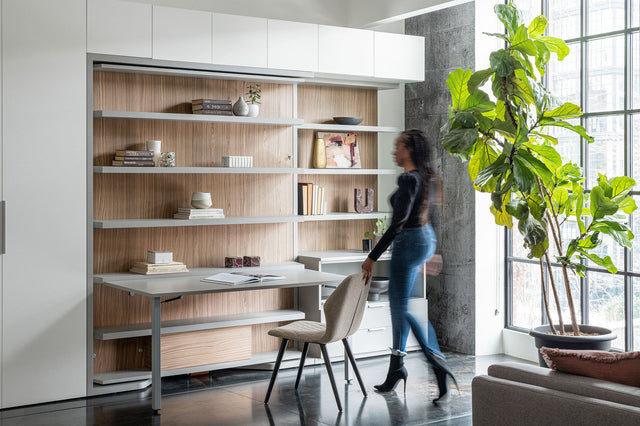
Go vertical with your storage. High ceilings? Use them. Wall-mounted shelves, cabinets, or pegboards keep your supplies organized and your floor clear. You could even install a wall bed with an attached desk—during the day, it's your work surface. At night, if you need to, it folds down into a guest bed. The desk stays level, so you don't even have to move your stuff.
Add a comfortable desk chair (your back will thank you), some task lighting, and maybe a small sofa or a couple of chairs for meetings or breaks. Since garages often lack windows, layered lighting is important—a good floor lamp and an adjustable desk lamp go a long way.
Paint the walls a color that doesn't make you want to fall asleep. Add a rug to make it cozy and help with sound. Personalize it. This is your space. Make it somewhere you actually want to spend time.
3. Create a Home Gym You'll Actually Use
Tired of paying for a gym membership you barely use? Your garage could be the answer. Converting it into a home gym means you can work out on your schedule, in your space, without waiting for equipment or dealing with crowds.
The key is maximizing open floor space. You need room for a treadmill or bike, plus space for weights, yoga, or whatever you're into. Wall-mounted and foldable equipment helps—think wall racks for weights or a fold-down bench that tucks away when you're not using it.
Make sure the space is comfortable. Insulate it properly and add climate control if needed. Nobody wants to work out in a freezing or sweltering garage. Put down rubber gym mats or cushioned flooring tiles over the concrete.
Storage keeps things tidy and safe. Modular shelving or cabinets can hold smaller equipment, towels, and accessories. Everything should have a home so you're not tripping over dumbbells.
If you occasionally need the space to double as a guest room, you can even add a Murphy bed or bunk bed system. It sounds unusual for a gym, but it works surprisingly well. Resource Furniture's Kali Duo bunk bed system, for example, closes into a sleek cabinet when you need the floor space, and opens up when someone needs to crash overnight.


Add a mirror (helps with form and makes the space feel bigger), mount a TV or Bluetooth speaker, and maybe create a small meditation corner if that's your thing. With good lighting and some motivational touches, you'll have a gym that's way better than the crowded one down the street.
4. Make It Your Creative Studio or Hobby Space
If you're an artist, crafter, woodworker, or just someone who needs space to make things, your garage could be perfect. It's slightly separated from the main house, so you can spread out, make some noise, or work late without bothering anyone.
Lighting is huge for creative work. If you can add a skylight or clerestory windows, do it. Natural light makes a massive difference. Some people even replace the garage door with French doors or a glass roll-up door to flood the space with daylight and create that indoor-outdoor vibe.
For your work area, think modular. Fold-down tables give you a big surface when you need it and clear floor space when you don't. A wall-mounted table that drops down works great as an art desk or sewing station. Resource Furniture has transforming tables that go from compact console to full-size worktable—perfect for when you need space but don't want it taking over 24/7.
Storage should be functional and within reach. Line the walls with shelves for supplies, or install pegboard panels to hang tools. A mix of open shelves and closed cabinets lets you display the stuff that inspires you and hide the mess.
If you want the studio to occasionally function as a guest room or hangout space, add a wall bed. When it's closed, it can have a bookcase or desk on the front. Most of the time, it stays up and acts as shelving for your art books or finished projects. If someone needs to crash, you've got a bed ready without sacrificing your creative space.
Personalize it. Paint an accent wall. Lay down a rug if you want it cozier. Add an easel by the window, pin up sketches, or set up a comfy chair for brainstorming. This is your sanctuary. Make it feel like one.
5. Build an ADU for Extra Income or Family
This is the big one. Converting your garage into a full ADU (Accessory Dwelling Unit) means creating a self-contained mini-apartment with its own entrance, bathroom, and kitchenette. You can rent it out for income, let an aging parent or grown kid live there, or use it as a high-end guest house.

This is a bigger project—you'll need permits, and you'll have to add plumbing and possibly HVAC. But if you can pull it off, the payoff is huge.
Multi-functional furniture is essential when you're packing everything into a one- or two-room layout. A Murphy bed with a sofa attached is perfect. During the day, it's a living room. At night, it's a bedroom. Same square footage, double the function. Resource Furniture's Swing or Tango sofa wall-bed systems are made for exactly this.
For the living area, keep seating simple—a loveseat or a couple of chairs. Add a transforming coffee table that lifts and expands into a dining table. You eliminate the need for a separate dining table, which is essential in a tight space.
In the kitchenette, use compact appliances and maximize vertical storage. Tall cabinets or a pantry unit with a pull-out rolling island for extra counter space works well.
If you're renting it out, a private entrance is a must. Make it feel independent from the main house. Add a little porch or some plants by the door to give it charm.
Design with light colors and good lighting so the small space doesn't feel cramped. If you can add windows or a glass door, do it. High ceilings help too—use lighting to draw the eye up and make the space feel bigger.
Done right, this becomes a flexible asset. Rent it out now, let family use it later, or reclaim it as your own space down the road. You have options at every stage of life.
FAQ: What You Need to Know About Garage Conversions
Do I need a permit to convert my garage?
In most cases, yes. You'll need permits for structural changes, electrical work, and plumbing if you're adding a bathroom or kitchenette. If you're creating a rental unit or ADU, you might need special zoning approval.
Start by checking with your local building department. They'll tell you about egress requirements (you may need to add a window or door for safe exit) and parking rules (some cities make you replace lost garage parking elsewhere on your property).
It sounds like a pain, but many cities are actually making it easier to convert garages into ADUs. Some even have streamlined permit processes. Do your homework upfront so the project is legal and safe.
How much do garage conversions cost?
It depends. A basic conversion—finishing walls, adding flooring and electrical—might run $5,000–$20,000. A full ADU with a bathroom and kitchen can cost $50,000–$150,000 or more. Most projects land somewhere in the $20,000–$50,000 range.
You'll save on some things (no new foundation or roof), but you'll spend on insulation, replacing the garage door, interior finishes, and potentially plumbing and HVAC upgrades.
The good news? Compared to building an addition, garage conversions are usually more cost-effective. And much of the expense can be recouped in home value or rental income over time.
Can I add a bathroom or kitchenette to a garage?
Absolutely. That's what turns a basic bonus room into a real living space. Adding a bathroom means running plumbing lines for water and sewer drainage. If the garage is detached or far from your house's main lines, it gets trickier, but a good contractor can figure it out.
Garages usually have a concrete slab floor, so you might need to cut into it to lay pipes, then re-pour. It's doable, just factor in the work and cost.
For a kitchenette, you'll need plumbing for a sink and electrical circuits for appliances (or a gas line if you're using gas). Ventilation matters too—you may need a vent hood or a window that opens.
Keep in mind, adding these features means more permits. But once they're in, you've massively increased the usability of the space. Even a half-bath and a small wet bar or kitchenette can make a huge difference.
How do I make my garage comfortable year-round?
Garages aren't built to the same standards as living spaces, so you'll need to beef up the insulation. Add it to the walls, ceiling, and ideally under the floor (or at least install a subfloor with insulation panels). This keeps the space from being freezing in winter and boiling in summer.
For heating and cooling, you have options. You can extend your home's HVAC ducts into the garage, but most people go with a mini-split unit. These wall-mounted units provide heat and AC without requiring ductwork, and you can control them separately from the main house. They're efficient and relatively easy to install.
Also, make sure you have proper ventilation. If the space is well-sealed, you might need an air vent or dehumidifier to prevent moisture buildup.
With good insulation and a solid HVAC plan, your converted garage will be just as comfortable as any other room in your house.
Will this increase my home's value?
Usually, yes. You're adding functional living space, which typically boosts value. HomeAdvisor reports that a well-done garage conversion can recoup up to 80% of its cost in added resale value.
A few things to consider: If you're in an area where covered parking is a big deal, losing the garage could turn off some buyers. In that case, you might want to create alternative parking or only convert part of the garage.
Quality matters. A conversion done without permits or one that still looks and feels like a garage probably won't add value. But a professionally finished space—or a well-designed ADU—absolutely adds appeal.
If you rent it out, it can be seen as an income-generating asset, which is attractive to buyers. And even if resale isn't your main concern, the lifestyle value you get from the space—the enjoyment and utility—is often just as important as the dollars it adds to your property.
How Resource Furniture Makes Garage Conversions Easier
By now, you're probably thinking about which conversion idea fits your life. But how do you actually furnish these spaces without making them feel cramped or cluttered?
Resource Furniture specializes in Italian-crafted transforming furniture designed for small spaces and multi-use rooms. Wall beds, modular sofas, expandable tables, clever storage—all built to make your garage conversion work around the clock.
Think of your converted garage as an extension of your home, not leftover space. Our design consultants have helped tons of homeowners turn blank garages into stunning, functional rooms that don't feel like garages at all.
For example, if you're into the guest suite or ADU idea, we have wall beds with integrated sofas or desks, bunk bed systems, and swivel beds that reveal shelving. They’re built for everyday use and come in finishes that work with your style. Need a big table occasionally for your home office? Our transforming tables go from coffee table to dining table, or from console desk to full workspace when you have people over.
Garage conversions ask a lot from furniture: pieces have to work hard and still look good. Our wall beds, sofas, and tables are designed with that in mind—clean lines, reliable mechanisms, and materials that hold up to daily use. Our wall beds are made in Italy and can be customized to suit your space and style.
Ready to get started? Reach out to our design team for a free consultation. We can help you plan the layout, recommend the right pieces, and customize finishes to match the rest of your home. Converting a garage can feel like a big leap, but with the right help, it can quickly become the best decision you've made for your home. Your dream space might be just a garage door away.
Recent Posts

How to Choose the Right Seating for Your Space: Sofas, Sectionals, Chairs & More

The Livability Quotient: A Better Way to Think About Multifamily Space

The West Coast Design Calendar: Los Angeles, San Francisco, and Seattle This Fall

A Battery Park City Home Built for Change

The Room Between Visits: Rethinking an Underused Bedroom in Los Angeles